
Quick answer: The life skills that matter most for kids ages 5 to 8 aren’t only chores. They’re the inner skills: calming down, waiting and saving, finishing what they start, handling worry, trying again, saying sorry for a mistake and moving on, making a friend. Researchers who followed children for decades found these skills linked to how those kids’ lives turned out at 25 and 32. The good news: they can be practiced at home, one skill a month, in about 10 minutes.
| At a glance | Ages 5–6 | Ages 7–8 |
|---|---|---|
| Goal | Know the 3 words and use them with you | Use the 3 words on their own, then tell you |
| Your role | Practice together on calm days, remind in the moment | Step back, remind less, ask “what did you use?” |
| Practice | 2–3 minutes, with toys or role-play | 5 minutes, plus one real try a week |
| How many skills | One a month | One a month (no rush to do more) |
| What counts as a win | Doing the steps with your help | Doing the steps before you say anything |
It’s 5:40 p.m. on a Tuesday. Your six-year-old loses a game of Uno and throws the cards across the living room. Twenty minutes later, they want to spend all their birthday money on a toy they’ll forget by Friday. At bedtime, it’s “I’m bad at reading, I can’t do it.”
You’ve said “calm down” a dozen times today. You’ve explained why saving matters. You’ve told them they’re a great reader. None of it stuck.
And somewhere in your head, a quieter thought: nobody taught me this stuff either.
You’re not alone in that. Most of us learned how to handle anger, money, worry and mistakes by getting it wrong for years. This guide is the checklist we wish our parents had: the 12 life skills that matter most for ages 5 to 8, what each one looks like at each age, and a simple way to teach them at home.
Why are life skills important for kids?
Because the skills a child practices at 5 don’t stay at 5. They show up at 15, at 25 and at 32.
That isn’t a guess. Two long-running studies followed real children into adulthood:
- The Dunedin Study followed about 1,000 children in New Zealand from birth to age 32. Children who had lower self-control (handling frustration, waiting, sticking with a task, controlling impulses) were more likely as adults to have health problems, substance dependence, trouble managing money and a criminal record. This held regardless of IQ or family background (Moffitt et al., PNAS, 2011).
- A Penn State and Duke study followed more than 700 children for nearly 20 years. For every one-point increase in their kindergarten social skills score (sharing, helping, solving problems with other kids), children were twice as likely to finish college and 46% more likely to have a full-time job at 25. For every one-point decrease, they had a 67% higher chance of having been arrested (Penn State summary of Jones, Greenberg & Crowley, American Journal of Public Health, 2015).
These studies show a link, not a guarantee. A child with a hard start isn’t doomed, and a calm child isn’t promised anything. But the pattern is clear enough that researchers keep repeating the same message: these skills matter long after childhood.
Here’s what that looks like in everyday life:
| Without practice | With practice |
|---|---|
| Throws the blocks when the tower falls | Cools down in 3 breaths |
| Spends the birthday money in 5 minutes | Saves part of it for something they really want |
| Starts ten things, finishes none | Picks one thing and finishes it |
| “I can’t” and quits after one fall | Counts the tries and stands back up |
| “It’s ruined!” over a small mistake | “Oops, that happened” and keeps going |
| Watches the other kids from the side | Walks up and asks to join |
Can life skills actually be taught?
Yes. And this is the part of the research that matters most for parents.
In the Dunedin Study, children whose self-control improved during the study did better as adults than their early scores predicted (Duke University fact sheet). These skills aren’t fixed traits. They grow with practice.
The catch is when you practice. Most of us try to teach calm in the middle of a meltdown, or patience while our kid is begging in the checkout line. That’s the worst possible moment. In the middle of a big feeling, nobody hears a speech.
Kids learn these skills the way they learn a fire drill: on a calm day, with something short enough to remember. We call it the Echo Effect: what you practice in the calm echoes back in the hard moment. A story they’ve heard five times, with three words they already know, is what comes back when things go wrong.
The 12 life skills checklist for kids 5–8
These are practice goals, not milestones. Every child moves at their own pace. Each skill has a 3-word method your child can remember and a small gesture that goes with it.
| # | Life skill | The 3 words | Ages 5–6: practicing | Ages 7–8: practicing |
|---|---|---|---|---|
| 1 | Calming down when angry | Feel it → Let it out → Cool it down | Names the feeling (“I’m mad”) and blows out 3 “birthday candles” with you | Notices the anger rising and uses the 3 breaths before yelling |
| 2 | Saving money | Pause → Plant → Grow | Waits before spending and puts part of a gift in a jar | Saves toward one goal for a few weeks |
| 3 | Focus and finishing | Look → Aim → Focus | Picks one thing (a puzzle, a drawing) and finishes it before starting another | Finishes a short task with one reminder |
| 4 | Spotting fake images | Zoom → Point → Ask | Knows pictures and videos can be made up, asks you when something looks strange | Zooms in and points at what looks wrong before believing it |
| 5 | Handling worry | Puff → Check → Release | Says the worry out loud and does a “balloon breath” with you | Checks “Is this likely?” and lets the worry go |
| 6 | Trying again | Notice it → Count it → Stand up | Tries again after one fall, with your cheering | Counts the tries and keeps going without “I can’t” |
| 7 | Gratitude | Put them on → See → Thank | Names one good thing from the day | Says thank you to someone without being reminded |
| 8 | Making friends | Align → Point → Ask | Gets close and says one sentence about the game | Asks to join and handles a “no” calmly |
| 9 | Caring for pets | Watch → Stop → Give what they need | Stops when the pet moves away | Reads simple signals (ears, tail) and helps with food and water |
| 10 | Respecting nature | Pause → Check → Return it | Puts rocks and bugs back where they found them | Checks the spot before leaving and leaves it as they found it |
| 11 | Handling mistakes | Tap → Say → Go | Says “Oops, that happened” after spilled milk, with your help | Fixes what can be fixed and keeps going |
| 12 | Washing hands | Lather → Scrub → Rinse | Lathers, scrubs and rinses with a reminder | Washes before meals and after the bathroom without a reminder |
Free printable: download this checklist as a one-page PDF to stick on the fridge. No email needed. Download the 12 Life Skills Checklist
How to teach life skills at home (in 10 minutes)
You don’t need a curriculum or a teaching degree. You need one skill, one short story and three words.
- Read it calm. Pick one skill for the month. Read a short story about it at bedtime or after lunch, when nobody is upset.
- Practice it. Act it out with toys for 2 minutes. The stuffed bear loses the game. What does the bear do? “Feel it, let it out, cool it down.”
- Say the 3 words. When the real moment comes, don’t explain. Just say the three words and do the gesture. Your child already knows the rest.
A 5-day plan for any skill
| Day | What to do (2–5 minutes) |
|---|---|
| 1 | Read the story or explain the 3 words with a toy |
| 2 | Act it out: you play the child, your child plays the guide |
| 3 | Practice the gesture together three times |
| 4 | Make a small “if-then” plan: “If the tower falls, then I…” |
| 5 | Your child teaches the 3 words to a stuffed animal or a younger sibling |
Then keep it alive: say the 3 words in real moments for the rest of the month.
Say this, not that
| Instead of… | Try… |
|---|---|
| “Calm down!” | “Feel it, let it out, cool it down.” (and blow with them) |
| “You’re going to waste all your money.” | “Pause. What do you really want?” |
| “Just try harder.” | “That’s try number 3. Stand up.” |
| “Why are you crying? It’s just milk.” | “Oops, that happened. What’s next?” |
Common mistakes
- Teaching in the middle of the storm. The lesson happens on calm days. In the hard moment, say three words, not a speech.
- Too many skills at once. One skill a month is enough. Twelve rules in a week means none of them stick.
- Two parents, two scripts. If one parent says “calm down” and the other says “go to your room,” the child hears noise. Use the same 3 words.
- Expecting it to work the first time. The first few times, your child will need you to start the words. That’s normal. That’s practice.
Life skills for 5-year-olds vs 7-year-olds
Ages 5–6: Keep it physical and short. The gesture matters more than the words: blowing out candles, puffing a balloon, tapping the table. You do the steps together, and you start them. A win is your child doing it with you.
Ages 7–8: Add the “why.” Ask them to explain the method to you, or to a sibling. Teaching someone else is one of the best ways to remember. Start reminding less. A win is your child using the words before you say anything, then telling you about it.
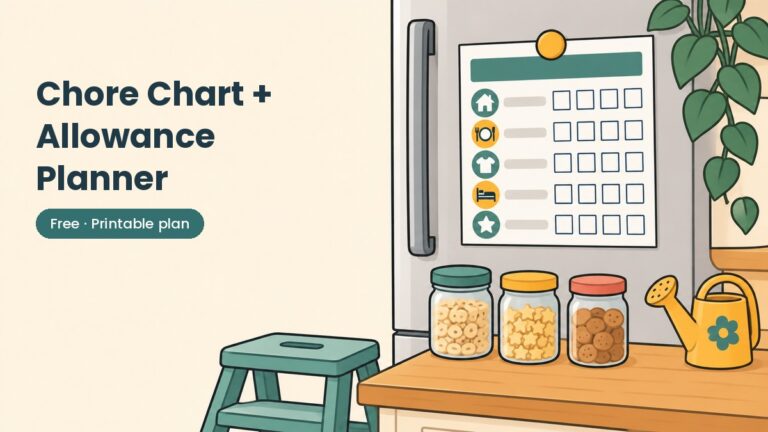
Want a practical skill to start this week? Try how to teach kids responsibility: one job, three steps and a chart on the fridge.
How to use this in your homeschool
Make life skills its own subject, one skill a month, 10 minutes a day:
- Week 1: read the story together and introduce the 3 words.
- Week 2: role-play and make a poster of the steps.
- Week 3: track every real-life use on a simple chart.
- Week 4: your child teaches it to a sibling, then gets a certificate.
It fits next to reading and math without adding prep, and it gives both parents the same words to use all day.
Get the full plan: Book 1 free
The checklist tells you what to teach. The stories are how it sticks.
Keenfolds is 12 illustrated books for kids 5–8, one for each skill on this list. One 10-minute story a month, each with its own 3-word method. Start with Book 1, The Volcano Method, free: the full story, the activities and the roadmap of all 12 skills.
Want the whole year? All 12 books are $47, one payment, no subscription, with a 30-day guarantee.
Every child moves at their own pace. The skills stick when you read together and use the 3 words in real moments. That part is yours.
Life skills for kids: FAQ
What life skills should a 5-year-old know?
At 5, focus on a few inner skills with simple steps: calming down when angry, washing hands properly (our guide on how to teach kids self care has the 3 steps), trying again after a mistake, and saying one sentence to join other kids. Practical tasks like putting toys away help too. Start with one skill a month.
At what age should you start teaching life skills?
You can start as soon as your child can follow a short story, usually around 4 or 5. There’s no deadline. Ages 5 to 8 are a great window because kids still love being read to and are ready for simple steps.
What are the most important life skills for kids?
Research points to self-control (handling frustration, waiting, focusing) and social skills (sharing, helping, joining in) as two of the strongest, both linked to how kids are doing at 25 and 32. Money, worry, gratitude and handling mistakes build on the same habit: knowing what to do when things get hard.
Do schools teach life skills?
Some, a little. Most school days are full with reading, math and science, so the inner skills usually happen at home. That’s why a short daily routine works better than waiting for someone else to cover it.
How long does it take to teach a life skill?
Plan on about a month per skill: a week to learn the 3 words, then three weeks of using them in real moments. Some kids get it faster, some need more time.
Written by Martín. I grew up in Chile, in school from 8 a.m. to 5 p.m. almost every day. I learned plenty of science, math and grammar. Nobody taught me how to handle anger, how to save money, how to focus, or what to do when worry takes over. I wish someone had taught me. So I made Keenfolds. I’m not a doctor or a teacher, just someone who never learned this.
Last updated: November 2, 2026.
Sources: Moffitt et al. (2011), “A gradient of childhood self-control predicts health, wealth, and public safety,” PNAS · Duke University, Dunedin Study fact sheet · Penn State, “Early prosocial behavior good predictor of kids’ future” (Jones, Greenberg & Crowley, American Journal of Public Health, 2015)