Quick answer: Kids ages 5 to 8 learn responsibility by owning one real job at a time, not by hearing reminders. Use three steps: show them the job once, do it together a few times, then hand it over with a chart as the “boss” instead of you. Start with one job for five days, say less in the moment, and let the chart do the reminding.
| At a glance | Ages 5–6 | Ages 7–8 |
|---|---|---|
| Jobs at once | 1 (add a second after 2 weeks) | 2–3 |
| Time per job | 2–5 minutes | 5–10 minutes |
| Your role | Show it, do it together, stay close | Hand it over, check the chart, step back |
| The reminder | A picture chart on the fridge | A written checklist they tick off |
| What counts as a win | Doing the steps with you nearby | Doing the job before you say a word |
It’s 8:10 a.m. You’ve asked for the shoes three times. “I don’t know where they are,” your seven-year-old says from the couch, eyes on the tablet.
You find them. You tie them. You carry the backpack to the car. And somewhere on the drive, a quieter thought: I’m doing his job.
Nothing is wrong with your child. Responsibility isn’t a personality trait that some kids have and others don’t. It’s a skill, and a skill gets built by practicing it, not by being reminded about it. Most of us were never taught how, so we default to the only tool we have: saying it again, louder.
Why does teaching responsibility matter?
Because a child who owns small jobs at 6 is practicing something bigger: doing the thing you’d rather skip, because it’s yours to do.
There is research behind the idea. One study followed 9,971 U.S. children from kindergarten to third grade. Parents reported how often their child did household chores in kindergarten. By third grade, kids who did chores more often rated themselves higher on social skills, academic ability and life satisfaction, and kids who did any chores were more likely to have higher math scores (White, DeBoer & Scharf, 2019, Journal of Developmental & Behavioral Pediatrics; Cornell summary).
Two honest caveats. This study shows a link, not a cause: the researchers adjusted for sex, family income and parent education, but families who assign chores may differ in other ways too. And the outcomes were self-reported by 8-year-olds. Treat it as a good reason to try, not a promise.
Not every study finds a benefit for every outcome. A 10-year study of California youth, assessed from ages 10 to 19, found no sign that doing more chores went along with growth in self-control (University of Houston summary). So chores aren’t magic. The point of this guide is practice and ownership: a job that is really theirs, and a plan that doesn’t depend on you remembering. We cover what research says about other skills in our guide to life skills for kids by age.
Here is what that looks like at home:
| Without practice | With practice |
|---|---|
| Waits for you to say it (again) | Checks the chart and starts |
| “I forgot” becomes the default answer | “I forgot” becomes “I’ll set it by my shoes” |
| You do it faster yourself | They do it slower, and it’s theirs |
| Hears “responsibility” as a lecture | Feels what it’s like to be counted on |
The good news: responsibility can be learned. It just can’t be learned from nagging.
What is the Handover Method?
Every tip below uses one simple routine, three words with a gesture:
Show it. Share it. Own it.
- Show it: do the job slowly, once, while your child watches. Say the steps out loud. Gesture: point two fingers at your eyes, then at the job.
- Share it: do it together for a few days. They do the steps; you stay close. Gesture: both hands on the job.
- Own it: open your palm and slide the job across to them, like passing a baton. From now on, the chart reminds them, not you.
Why it works: nagging makes you the keeper of the job. The handover moves the job, and the memory of the job, to your child. When something is theirs, there is nothing left to remind them about except a chart.
This one isn’t from our book series; it’s a general routine for any household job. The same three-step shape (“learn it calm, practice it, then use it”) is how every Keenfolds skill works.
How do you teach responsibility? A 5-day plan
One job. Five days. Two to five minutes each, at the same time every day (after breakfast works well).
| Day | What to do | Time |
|---|---|---|
| 1 | Pick one job together. Let your child choose from 3 options. Write or draw it on the chart. | 3 min |
| 2 | Show it. Do the job slowly while they watch. Say each step out loud. | 3 min |
| 3 | Share it. Do it together. They do the steps; you only point. | 5 min |
| 4 | Make an if-then plan: “If I take off my shoes, then I put them on the shoe shelf.” Then hand it over: they do it alone while you stay nearby. | 5 min |
| 5 | Your child teaches the job to a stuffed animal or a younger sibling. Tick the chart together. | 5 min |
After day 5, keep the one job going for two more weeks before adding another. The first week will be wobbly. That’s normal. That’s practice.
What are good jobs for ages 5–6 and 7–8?
Answer first: pick jobs that are visible, finishable and low-risk. Anything with knives, the stove or cleaning chemicals stays with you for now.
| Job | Ages 5–6 | Ages 7–8 |
|---|---|---|
| Own stuff | Dirty clothes in the hamper, shoes on the shelf | Packs their own backpack from a checklist |
| Bed and room | Pulls up the covers, puts toys in a bin | Makes the bed, tidies the floor before bed |
| Meals | Sets out napkins and forks, clears their own plate | Sets the table, helps wipe it, packs a cold-snack lunch |
| Pet and plants | Fills the pet’s water, waters a plant | Feeds the pet, measures the food |
| Laundry | Matches socks | Sorts light and dark, folds towels |
| Dishes | Carries their dish to the sink | Unloads the dishwasher (non-breakables) |
One job from the table is plenty to start. More jobs at once is the fastest way to turn this into a fight. Body routines like handwashing and teeth are their own skill: see how to teach kids self care.
What should you say instead of nagging?
Answer first: say fewer words, say them calmly, and send the reminder to the chart. A repeated command teaches your child that the first three asks don’t count.
| Not that | Say this instead |
|---|---|
| “I’ve told you three times!” | “Check the chart.” |
| “Why can’t you ever remember?” | “What helps you remember? Let’s make a plan.” |
| “Fine, I’ll do it myself.” | “I’ll wait. Tell me when it’s done.” |
| “Good job!” | “You did it before I asked. How did you remember?” |
| “You’re so lazy.” | “That job is still waiting. What’s the first step?” |
| “Hurry up, we’re late!” (at the door) | “Shoes are on the shelf. You’ve got this one.” |
The left column isn’t wrong because you’re a bad parent. It’s the wrong tool for the moment. Praise effort and the plan, not the result, and stay calm when a job comes back half-done. Then ask what they’d change next time.
What mistakes should you avoid?
- Redoing the job in front of them. If they made the bed lopsided, leave it until they’re gone. Fixing it while they watch teaches them their work doesn’t count.
- Too many jobs at once. One job, two weeks, then add another.
- Teaching it in the middle of the rush. The lesson happens on calm days. At 8:10 a.m., you say three words, not a speech.
- Two parents, two systems. If one parent reminds and the other lets it slide, the chart loses its authority. Use the same chart and the same words.
- Waiting for perfect. A job done 70% well by your child is worth more than a job done 100% well by you.
What about allowance?
Answer first: money is a separate skill from responsibility, and families split on whether to pay for chores. Many separate “family jobs” (unpaid, because we all live here) from “extra jobs” (paid), but you choose what fits your family.
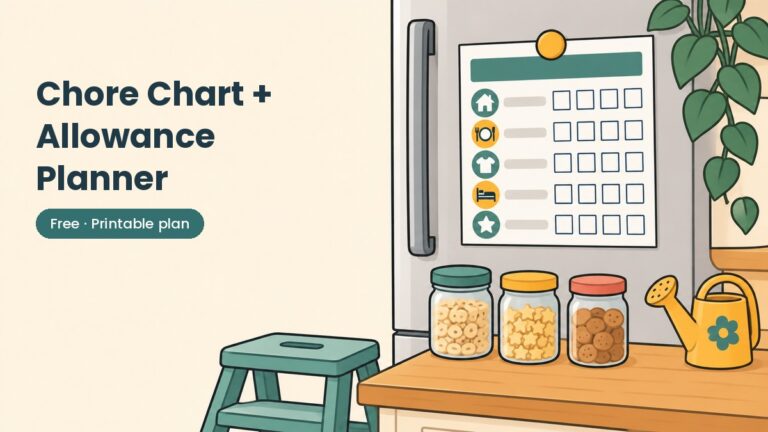
If you want to add money later, do it after the job is already a habit. Then teach what to do with it. That’s a different skill with its own 3-word method: in Keenfolds, it’s Book 2, The Seed to Tree Method (Pause, Plant, Grow). You can also build a custom weekly chart with our free Chore Chart and Allowance Planner.
How do you adjust for ages 5–6 and 7–8?
Ages 5–6: keep it physical and short. Use a picture chart. Do the job together for longer. A win is your child doing the steps with you nearby. Expect to start the first step every time for a while.
Ages 7–8: add the “why” and the plan. Ask them to explain the job to you, or to a younger child. Switch to a written checklist, and let them tick it off. A win is your child starting the job before you say anything, then telling you about it.
How can you use this in your homeschool?
Responsibility is already part of your school day. You just haven’t labeled it.
- Give each child a school box. They pack it and put it back, not you.
- Use a morning job board. Two jobs first, then lessons. Tick them off before the day starts.
- Make “independent work” a handover. Show the task, do the first problem together, then hand over the rest with a checklist.
- Let them close the day. The last five minutes are for putting their own materials away.
Free printable: my job chart
Download the My Job Chart: a one-page weekly chart with picture jobs for ages 5–6 and a tick-box version for ages 7–8. Free, no email needed.
Want the full set? Add your email and get the Handover Pack (6 pages): the 5-day plan, jobs by age, “say this, not that” cards, an if-then planner for your child, a fridge poster and a two-week “Who started it?” tracker.
FREE · 6-PAGE PDF
Get the Handover Pack
The 5-day plan, jobs by age, say-this cards, an if-then planner, a fridge poster and a two-week tracker.
No spam. Unsubscribe anytime.
How to teach kids responsibility: FAQ
At what age can kids start doing chores?
As soon as they can follow a one-step instruction, which is usually around 3 or 4. The study above looked at kindergartners, and 5 to 8 is a good window because kids still like helping and can follow a short routine.
How do I teach responsibility without nagging?
Move the reminder from your voice to a chart. Show the job once, do it together a few times, then say only “check the chart.” If it wasn’t done, wait before you step in, and ask “what’s the first step?”
Should kids get paid for chores?
It’s your call. Some families keep family jobs unpaid and pay for extra jobs; others don’t pay at all. If you add money, do it after the job is a habit, and teach saving as its own skill.
How many chores is too many for a 6-year-old?
Start with one, then add a second after two weeks. Two to five minutes a day is plenty. If it turns into a daily fight, drop to one job for a few days.
What if my child refuses?
Stay calm, don’t argue, and offer a choice between two jobs. If they still refuse, say “I’ll wait” and skip the lecture. Try again tomorrow. Consistency matters more than winning one morning.
Keep practicing with a story
Responsibility is one of many skills nobody taught us. Keenfolds is 12 illustrated books for kids 5 to 8, one 10-minute story a month, each with its own 3-word method. Start with Book 1, The Volcano Method, free: the full story, the activities and the roadmap of all 12 skills.
Teaching responsibility sits next to all 12 skills in our life skills for kids by age checklist, and Book 2 covers the money side of it. Every child moves at their own pace. The skills stick when you practice together in real moments. That part is yours.
Last updated: November 9, 2026.
Sources: White, DeBoer & Scharf (2019), “Associations Between Household Chores and Childhood Self-Competency,” Journal of Developmental & Behavioral Pediatrics · Cornell University, “Research Confirms That Chores Are Good for Kids” · University of Houston (Damian et al., 2019), “Household chores in childhood not linked to self-control development”