If you’re reading this at 9pm, phone in hand, wondering whether you should be more worried about your kid’s screen time than you already are — you’re not overreacting. You’re paying attention.
Quick answer: the signs that matter most aren’t about the number of hours on a clock. They’re about what’s changing around the screen — mood, sleep, attention, and how hard it is to get your kid to stop. Here are the five that actually mean something.
1. Getting off the device causes a bigger reaction than it used to
Every kid protests a little when a screen gets taken away — that’s normal. What’s worth noticing is if the reaction has gotten sharper over time: more yelling, more negotiating, more genuine distress over something that used to be a quick “okay, five more minutes” conversation. That shift usually says more than the raw number of hours does.
2. They’re harder to pull into anything that isn’t a screen
If a board game, a book, or an activity that used to hold their attention now gets a flat “I’m bored” within a few minutes, that’s worth paying attention to. It doesn’t mean something is permanently broken — but it does mean their attention has gotten used to a pace that almost nothing offline can match, because almost nothing offline is built to.
3. Sleep is getting harder — for them, or for the whole house
Screens close to bedtime are linked to disrupted sleep in a lot of research, and you don’t need a study to notice it if it’s happening in your own house: a kid who’s suddenly harder to get to bed, wakes up groggier, or sneaks a device after lights-out. This is one of the more reliable signs, because sleep problems tend to show up before other things do.
4. Mood swings show up more around screen time specifically
Not every mood swing is about a screen. But if you can predict a rough patch is coming based on how long they’ve been on a device, or how the transition off of it goes, that pattern is worth naming — not as a diagnosis, just as information that helps you plan around it.
5. They’re finding workarounds for the limits you’ve set
This is the one most parents don’t expect, and it’s often the clearest sign of all: your kid figuring out how to get around a screen time app, sneaking a device into another room, or finding an unrestricted device somewhere in the house. If this is happening, it’s not really about your rule — it’s a sign the pull toward the screen is stronger than the consequence of breaking the rule.
If you’re seeing two or three of these — it’s not you
Here’s the part that’s easy to forget in the moment: the apps and games your kid is drawn to weren’t built by accident. They’re designed by teams of people whose entire job is making it hard to walk away — infinite scroll, notifications, rewards that show up just often enough to keep pulling you back. You’re not failing at something everyone else has figured out. You’re up against something engineered to win.
That doesn’t mean there’s nothing to do. It means the fix probably isn’t another rule or another app limit — those get worked around, as sign #5 shows. It usually means finding something that can actually compete for your kid’s attention on its own terms, not just restrict the thing that’s already winning.
What to do next
If a couple of these signs sound familiar, you don’t need to overhaul everything tonight. Start with one thing: have a genuinely engaging offline option ready for the moments you’d otherwise hand over the tablet. That’s less about willpower and more about having a real alternative on hand before the moment happens.
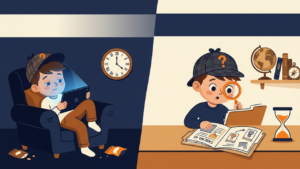
If you want to see what that looks like in practice, The Bay Hollow Files gives kids a real mystery to solve — one case at a time, no screens involved. You can try one full case completely free, no credit card, before deciding if it’s the right fit for your kid.

How do I know if my kid has too much screen time?
Look past the hours on the clock. The clearest signs are behavioral: bigger reactions when a device is taken away, trouble sleeping, mood swings tied to screen use, and — the strongest sign — finding ways around the limits you’ve already set.
Are screen time apps and limits enough on their own?
Usually not by themselves. Most screen time controls rely on the child not finding a workaround, and kids are often resourceful enough to find one. Limits work better paired with a real alternative activity, not as the only strategy.
Is it normal for kids to get upset when screen time ends?
Some pushback is normal. What’s worth paying attention to is whether that reaction has gotten more intense over time, or whether it’s paired with other signs like sleep trouble or finding workarounds around your rules.